The Bottleneck That Moves

March 17, 2026
Why automation projects solve the wrong problem
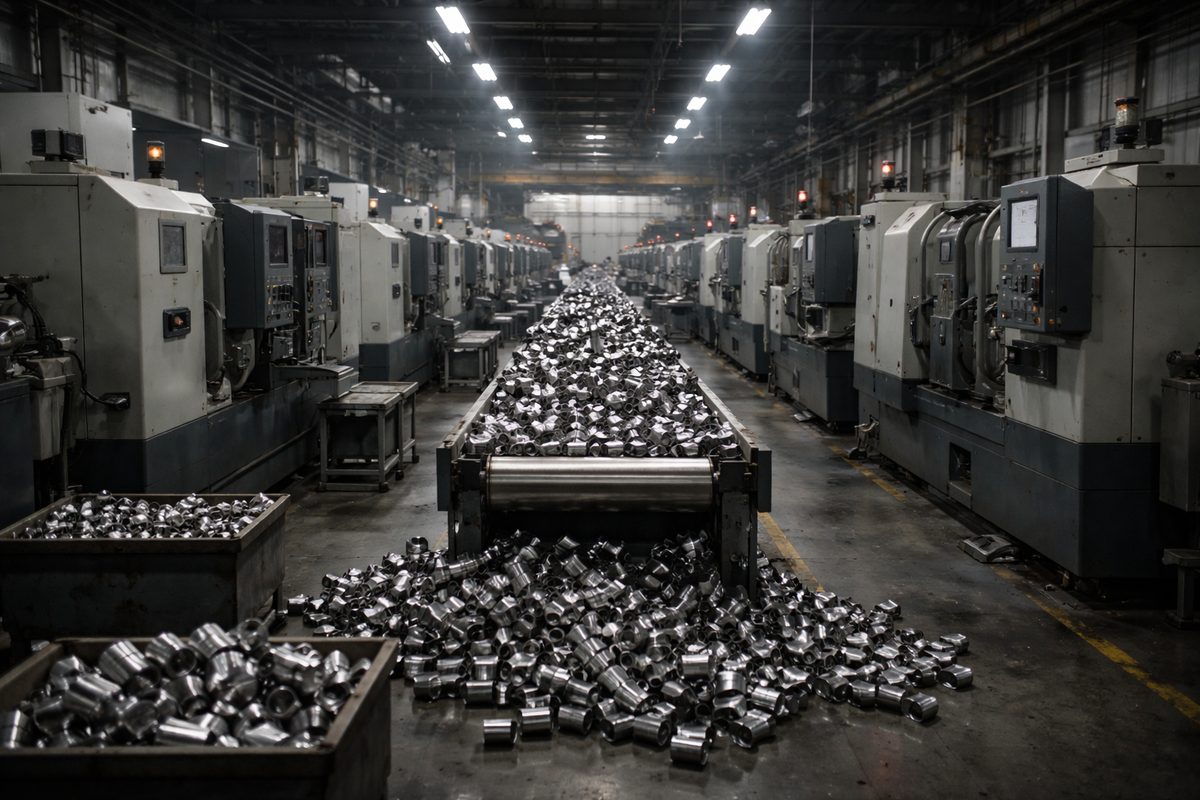
Every factory has a constraint everyone agrees on. The welding station that can't keep up. The packaging line that backs up every afternoon. The inspection step where parts queue for hours. It's obvious, it's measurable, and it's where the automation budget goes.
Six months after the new system is installed, throughput hasn't changed. The welding station now runs at twice the speed, but parts still take the same time to reach shipping. The bottleneck didn't disappear. It moved.
This happens more often than anyone admits, because the mental model of a production line as a sequence of independent steps is wrong. A factory is a system, and systems have the annoying property that improving one part can make another part worse. Speed up welding and you've created a queue at the next station. Eliminate that queue and you've exposed a capacity problem in material handling. Fix material handling and now your scheduling system can't cope with the new pace.
The constraint you can see is rarely the constraint that matters. The visible bottleneck is just where inventory accumulates, which tells you something is wrong upstream or downstream but doesn't tell you what. The actual limiting factor might be a policy decision made years ago, a shift pattern that nobody questions, a supplier lead time that everyone works around, or a quality issue that creates rework loops invisible to the production metrics.
Automation vendors don't think in systems. They think in stations, because stations are what they sell. Point at the slow machine and they'll quote you a faster one. The question of whether a faster machine actually improves output is outside their scope, and honestly outside their interest. They get paid either way.
The companies that avoid this trap do something unsexy before they spend money: they map the actual flow. Not the process diagram on the wall, which shows how things are supposed to work, but the real path parts take through the facility, including the unofficial queues, the rework loops, the workarounds operators invented that nobody documented. This is tedious work that produces an ugly picture, and that ugliness is the point. You can't improve a system you don't understand, and you don't understand a system until you've seen what actually happens.
Theory of Constraints has been around for forty years and still gets ignored, not because it's complicated but because it's inconvenient. It tells you that only one constraint matters at a time, that improving anything else is waste, and that the constraint is probably not where you think it is. None of this helps justify the capital expenditure request that's already been written.
The fix isn't more analysis before buying equipment. It's a different question at the start. Not "how do we speed up this station?" but "what would actually have to change for output to increase?" Sometimes the answer is a machine. Often it's a policy, a schedule, a supplier relationship, or an organizational boundary that nobody wants to touch. The automation project is easier to approve than the conversation about why second shift runs at 60% of first shift capacity.
Bottlenecks don't hold still. Solve one and another appears, because that's how systems work. The goal isn't to eliminate constraints — that's impossible — but to choose which constraint you want and design around it. That's a strategic decision, not an equipment purchase.